Showing posts with label one minute workout. Show all posts

Wednesday, January 21, 2015

The One Minute Workout is Now on Amazon Kindle

Specially made for all you e-book lovers out there, The One Minute Workout is now available for all Kindle devices! Get your copy at http://amzn.to/15sCNxS


Since you can't flip through an e-book quickly like the paperback version, we added some navigation features to make it easier to use as intended—a quick reference for a quick workout. Here they are:

  • Exercise Links Menu
    Found at the beginning of each Progression Chapter. Use it to jump quickly to any exercise in the chapter.

  • Exercise Map Links List
    Making the Exercise Map clickable just didn't work consistently across the many Kindle platforms. This was the next best thing.

  • Navigation Bar
    Located at the top of each exercise entry. Use it to go back and forth quickly through the exercises or jump back to the start of the chapter.

We tried adding a table of contents just for the exercises but with so many exercises in the book, it actually took many more clicks to get to many of the exercises compared to going through the book's table of contents and the Exercise Links Menu.

If you have any comments, questions, or suggestions, let us know. Spread the word and don't forget to share your copy with those you care about!

Monday, January 12, 2015

Trying to Lose Weight? Avoid the #1 Mistake Dieters Make


“I’m going on a diet!” That’s the first thing most people say when they want to lose fat or weight. But if that’s the first step you take, you’re already doing the wrong thing and setting yourself up for failure. Let me explain why.

Losing weight is as much a mental game of desires and discipline as it is a physical game of calories eaten and burned. Your body weight and composition reflects your inputs and outputs over time. If you change any of these for long enough, your weight will change accordingly. So, with enough time, any sort of change in diet will change your weight. But once you go back to your previous way of eating, your weight will return to that weight.

For example, you may lose a few pounds by starving yourself for a day or two. But when you stop fasting and go back to eating like you used to, you will return to your pre-starvation weight a few days later. All of that suffering will have been for nothing.

Fortunately, the same thing happens if you eat too much for a day or two. While your weight may go up for a few days, you can return to your pre-feast weight just by going back to your previous eating habits. So don’t freak out and punish yourself for indulging once in a while!

Now, how does this relate to going on a diet? When most people say “I’m going on a diet”, they are implying making a temporary change to their eating habits. Since they think it’s only going to be temporary, they’ll try almost anything to reach that arbitrary target number. Once they reach their target weight, they go back to their pre-diet eating habits. And to their dismay, their body goes back to the pre-diet weight. This is the #1 mistake people make when attempting to lose weight: trying to make a permanent change in their body by making temporary changes in their actions.

So, if dieting doesn’t work, what can you do? Rather than “going on a diet,” use the following mindset: “I’m going to change my diet!” This implies making permanent changes which will yield lasting results. In the end, this is what we really want for our looks and for our health.

With that in mind, choose methods that you can sustain indefinitely right from the beginning. In my book, The One Minute Workout, you’ll find a whole chapter called “What Should I Eat?”on making sustainable changes to your eating habits. One of the simplest techniques from that chapter that you can use right away is to only make small changes at a time. Doing so will enable your mind and body to adjust to the changes and allow them to become part of your eating habit. This is a lot easier than “going on a diet” where you do will-busting things like starving or depriving yourself of your favorite foods!

Friday, January 9, 2015

The #1 Problem with Fitness Resolutions and How to Beat It

Did you promise yourself to get in better shape or lose weight this year? If you’re like most people around now, you're really motivated and might even have a workout plan in mind. But will you be able to stick with it and reach your goal? More importantly, once you get there, can you maintain your results indefinitely?

This is the biggest problem with fitness resolutions and many workout programs. We all want to be healthier (and look better!) but we often don’t plan for the long term. What really matters is your current state of fitness and how long you can stay in shape. You could have been the fittest person on earth a couple of years ago but if you’re overweight and out-of-shape now, then your health is still at risk.

Long-term success is the result of consistency and a fail-proof way to be consistent is to turn productive actions into habits. When something becomes a habit, it becomes second-nature and requires much less, if any will power to do it. It takes priority in your mind over other obligations that compete for your time and attention. This is why people with good workout habits always seem to find time to exercise while others can never find the time and make excuses.


When you decide to get in shape, you may be tempted to jump right into one of the many intense workout programs out there. And that’s fine if you can do them consistently. Just make sure you don’t go overboard and end up injuring yourself as that’s the fastest way to sabotage your resolution.

Keep in mind that the novelty of the workout and your enthusiasm is inevitably going to wear off. The boot camp or workout program you saw on TV is going to seem a lot less fun and become a chore, especially as other obligations pop up and consume your valuable time. If you haven't established a workout habit, then there is a very high chance that you’ll stop doing it sooner or later. When that happens, any benefits you may have gained start going out the window, as though you never worked out.

A better idea is to ease into working out so it’s easier to establish a workout habit. Start with a regimen that is easy to fit into your schedule. This way, it’s not a Herculean task to regularly carve out time for your workout. 

Don’t choose exercises which are too easy since you’ll be discouraged by the lack of noticeable results. Also, don’t pick excessively intense workouts, unless you like frequent next-day soreness.

Instead, do exercises that push your limits just a bit. This will give you more positive results and less negative effects. As you get in better shape, increase the intensity of the exercise but NOT the time spent working out. This keeps the results coming without growing your workout into an unmanageable time-sucking chore. In other words, work out smarter, not longer.

If you’re looking for a sustainable workout that grows with you, take a look at The One Minute Workout. This time-efficient workout system (just 60 seconds a day) grows with you as you progress and is a great way to establish a workout habit that you can maintain indefinitely. If you end up using another workout program, remember to choose wisely and think about the long-term. Be consistent and don't let exercise consume your life. Time-limited programs such as the 30-, 60-, or 90-day challenges can be good but you'll need to keep working out even after the program is over. If you can't keep up with your workout, use something simpler like The One Minute Workout to maintain your gains.

Friday, December 12, 2014

Building Strength - The First Step to Staying Active and Healthy

Here's an article I wrote for the November 22, 2014 issue of The Sounds, a local Chicago newspaper.

In my last article, I mentioned several different aspects of fitness. While they are all important, some are more essential than others these days. As a doctor, the most common fitness deficiency I have observed is inadequate and/or unbalanced strength. I see this across the board in people of all ages. Younger people commonly develop chronic back and joint pain from poor posture or injuries. Many older people live a lower quality of life due to their inability to move around safely and independently. Unfortunately, many end up in the hospital after falling and sustaining life-threatening injuries.

Why is strength so important? Strength is the foundation of all movement, and movement is essential to health. The less strength you have, the harder it is to move around, which makes you less inclined to be active. As a result, your muscles become even weaker. This vicious cycle continues and before you know it, you are out-of-shape and suffering from various pains and health conditions.

Being strong isn’t about being bigger, looking ripped, or being able to lift heavy weights. It’s about making activities easier for yourself so that you don’t strain your body as much. This includes your heart and muscles as well as joints, ligaments and tendons. Strong, balanced muscles can help improve body posture, decrease the risk of injury, and reduce or even eliminate certain kinds of back and joint pain.

Fortunately, strength can be the easiest and least time-consuming aspect of fitness to build. Contrary to common belief, building strength doesn’t require going to the gym and lifting weights for hours. When your muscles are exposed to loads greater than they are accustomed to, even for short periods of time, they respond by growing stronger. This response occurs whether the load is from gym weights, heavy bags of groceries, or just your own body weight. In fact, you can build significant strength by training appropriately in as little as one minute a day, without any special equipment.

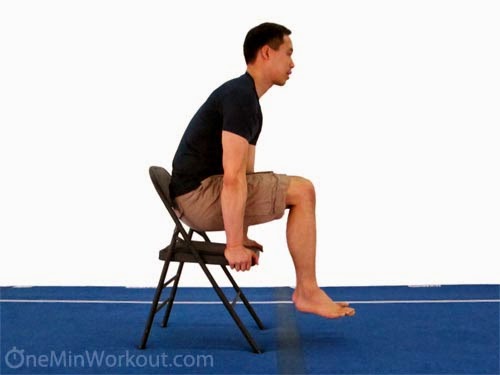
Try the following exercise from my One Minute Workout. Using a stable chair, hold the “Tuck Sit Press” position shown below for as long as you can. Do your best to lift your feet off the ground. If you can’t, then let your feet touch the ground lightly but minimize the amount of weight placed on them. This is called a “Rising Chair Press”.

Count or use a clock to time yourself. Stop when you get tired or when 60 seconds is up, whichever comes first. You should feel the muscles in your arms, chest, upper back, abs, and hip flexors strongly engaged during this exercise.

Tuck Sit Press - One Minute Workout
Tuck Sit Press

Tip: If you have a chair with solid armrests, it may be easier to use those as supports. You can also use two chairs placed shoulder-width apart, putting one hand on each chair seat.


Whether you finished a whole minute or not, chances are your abs started burning or your arms started shaking while doing the above exercise. That’s proof that your muscles were getting an intense workout. In just those few seconds, you blasted your chest, shoulders, arms, back, abs and hip flexors simultaneously. That’s almost your whole body! This is an example of how you can build significant strength without spending much time.

To maximize results, finish your One Minute Workout for the day by repeating this exercise throughout the day until you accumulate a total of 60 seconds. Do this exercise daily, push yourself a little longer each time, and you’ll grow stronger and feel better.

Thursday, November 20, 2014

"The One Minute Workout" Book is Officially Launched!


It’s taken over 4 years of hard work but the book is finally out! You can find it at Amazon (http://amzn.to/1nfv1cg) and soon, at a bookstore near you. Thanks to everybody who helped and supported me so far with this project. I couldn’t have done it without you.

You can find out more about how and why the One Minute Workout works from the main website (http://oneminworkout.com) so I won’t go over that again here. Instead, I’d like to say a few words about what I hope to accomplish with this project.

As a doctor, I’ve seen many people suffer the consequences of being overweight and overly inactive. They get diabetes, high blood pressure, heart attacks, strokes, addiction to pain killer medications, you name it. The sad thing is all of those things are largely preventable. Some are even reversible! We all know exercise is the answer but for some reason, it’s so much easier said than done. Healthcare professionals try to counsel their patients about diet and exercise but the results are not very encouraging.

I’ve thought about this for a long time and it wasn’t until I personally became out of shape and overweight when I realized what the problem was. Movement is essential to health and strength is the foundation of all movement. Therefore, we should be focusing first on strength!

We doctors usually counsel our patients about doing “cardio” activities to improve and maintain health. Recommendations often include walking, biking, running and swimming. But when you’re out of shape, your muscles are weak so moving is really hard work! It’s no wonder people rarely stick with our exercise recommendations. Plus, these “cardio” activities takes a lot of time, which many of us don’t have to spare these days. Now, some physicians do recommend some form of strength training but just telling people to start lifting weights isn’t very effective. They need regular guidance or a plan to follow so they get the results they need.

This epiphany led me to create the One Minute Workout. Sure enough, after I started using this convenient workout system and building strength, I started moving much more easily. As a result of moving better, I felt better, and I started looking better as well. With some adjustments in my eating habits to match my activity level, I lost the extra fat weight and gained significant lean muscle mass. Now I’m in the best shape of my life and am much stronger than when I used to lift weights at the gym regularly.

With inactivity and obesity rates increasing worldwide, this workout system addresses a fundamental part of the puzzle that is often overlooked by healthcare providers. It has already helped many people and I’m hoping it will help even more now that it’s available in book form.

We all know someone we care about who can benefit from exercise. Please share this with your friends and family - together we can beat this epidemic!

Monday, November 3, 2014

Hello and Welcome!

My name is Ray Wu and I'm the author of The One Minute Workout. For those of you who haven’t read the book, I created this workout as a way to get myself back into shape after years of neglect. The goal of this workout system isn’t to turn you into a fitness model or a bodybuilder, but to give you a no-nonsense way to improve your health by helping you move and feel better. It just so happens that this system can also help you build significant lean muscle and tremendous functional strength.

Here’s how it came to be. To make a long story short, I used to be quite active playing many sports and studying martial arts. Then I started working long hours during my medical residency, which left me with little time to exercise like I used to. Before I knew it, I was overweight, out-of-shape, and in pain from sitting so many hours each day. After many failed attempts to get back in shape, I finally created a workout system that worked with my busy schedule and my lack of access to exercise equipment. Most importantly, it helped me get out of the chair regularly and eliminated my pain from prolonged sitting. Now, I feel great and am in the best shape of my life. After seeing how well it worked for me, I started sharing it with others, many who have reported great results as well. This book and website were created to help even more people reap the same benefits we have enjoyed from this highly effective system.

As a medical doctor trained in internal medicine, I've seen people from many walks of life. Almost universally, people want to stay healthy but many don't know how or where to start. Sometimes, it’s due to a lack of knowledge or a lack of motivation. Other times, it’s due to confusion from all of the conflicting news stories and studies coming out. As a result, many people develop bodily pains and health conditions that limit what they can do and how much they can get out of life. Unfortunately, many doctors are time-strapped and ill-equipped to help their patients beyond giving generic advice like “eat better and exercise more”. The One Minute Workout is designed to be a tool for clinicians and patients alike to combat obesity epidemic that is underway around the world.

My goal here is to help you become healthier so you can get the most out of your life. Through this blog, I plan to explore some of my insights on the topics of fitness, nutrition, and health, especially those that didn’t make it into the book. I hope you find it useful, a source of inspiration, and a trigger to take action. To your health and happy reading!